Open Supervised Device Protocol

Build and certify OSDP systems
with ease.

A full suite of hardware and software tools for engineering teams integrating Open Supervised Device Protocol — from bus capture and emulation to field deployment.

osdp.dev — live bus capture
# Bus: /dev/ttyUSB0 @ 9600 baud# Secure channel: active (AES-128)────────────────────────────────────────0.301ERR CP → PD[1] POLL len=80.600CMD CP → PD[1] CAP len=8 CRC16✓0.601CMD CP → PD[1] POLL len=8 CRC16✓0.900RPL PD[1] → CP ACK len=8 CRC16✓0.901CMD CP → PD[1] POLL len=8 CRC16✓1.200RPL PD[1] → CP CCRYPT len=8 CRC16✓1.200RPL PD[1] → CP ACK len=8 CRC16✓1.500RPL PD[1] → CP ACK len=8 CRC16✓1.500CMD CP → PD[1] CAP len=8 CRC16✓──────────────────────────────────────── SOM: 0x53 Type: Reply (1) Addr: 1 Len: 8 Seq: 0 Payload: ACK Checksum: AABB ✓

Success: OSDP v2.2 Verified!
OSDPIEC 60839-11-5
Open SourceLibOSDP core
Secure ChannelWorks Out-of-the-box
CP & PDMode Support
RS-485Multi-Drop
Bare-metal & RTOSDesigned for Embedded
Rust, Go, PythonLanguage Bindings
What is OSDP

Modern access control,
on an open standard

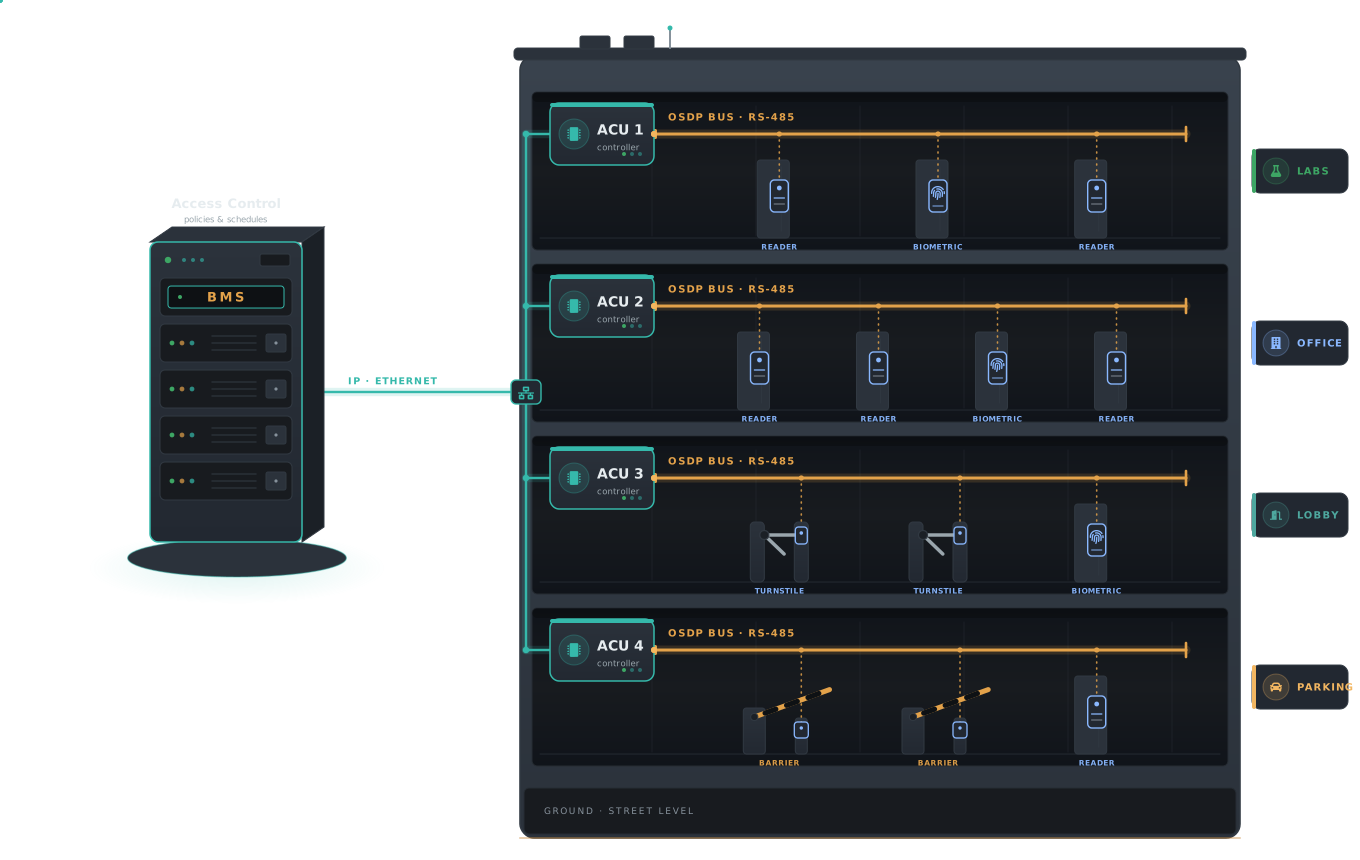
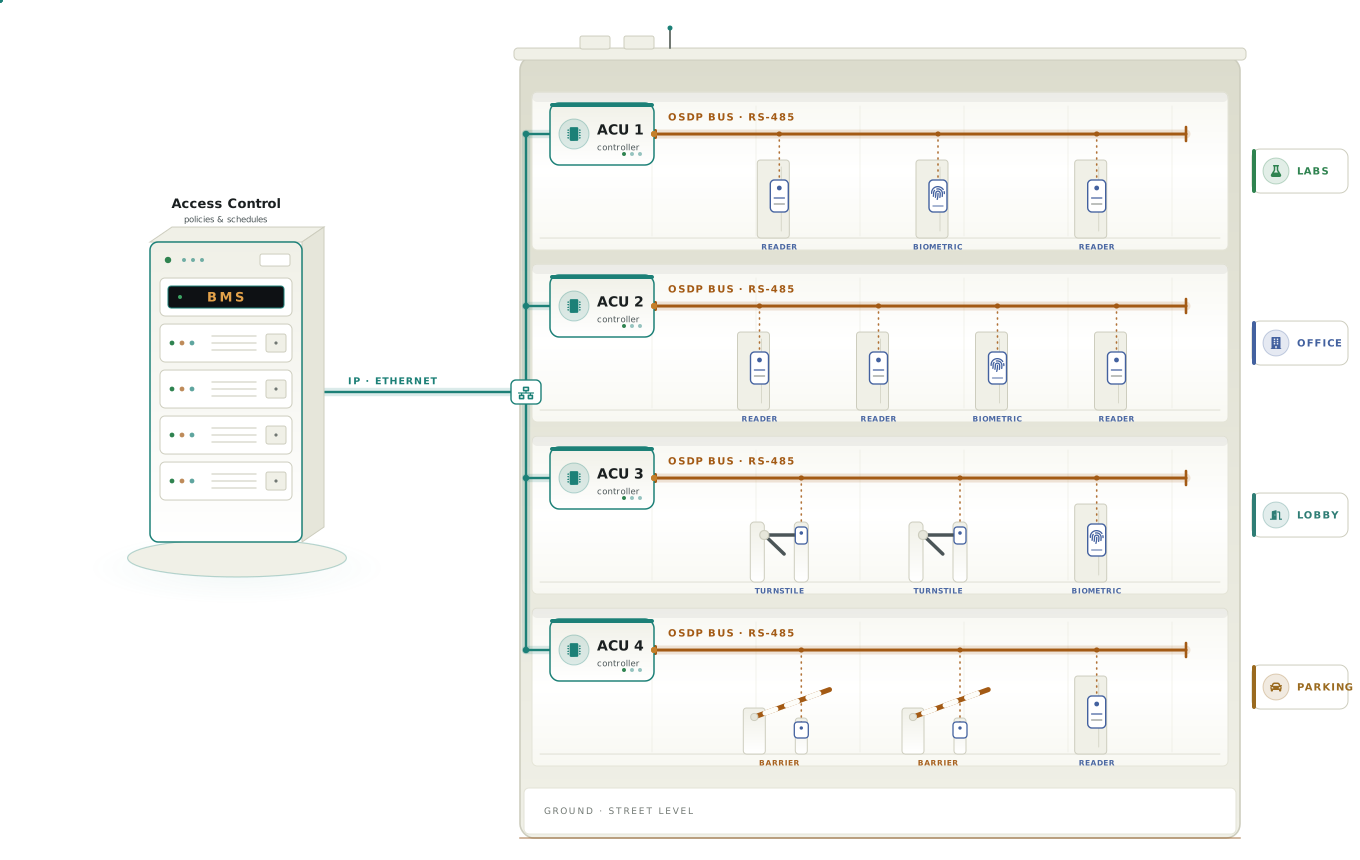
OSDP — the Open Supervised Device Protocol — is the IEC 60839-11-5 standard for how access control panels talk to the readers, keypads, and controllers in the field. It is secure, bidirectional, and vendor-neutral: one open protocol for the whole bus.

For nearly forty years that bus spoke Wiegand — a one-way, unencrypted signaling scheme still wired into most card readers in service today. Its weaknesses are now well understood, and as encryption and line supervision become baseline security expectations, standards bodies and government procurement increasingly specify OSDP for new and upgraded installations. The changeover is gradual, but the direction is set.

CapabilityLegacy Wiegandincumbent · since the 1980sOSDPtoday's standard
CommunicationOne-way — reader to panel onlyBidirectional command and reply
Data securityUnencrypted — credentials sent in the clearAES-128 Secure Channel encryption
Line supervisionUnsupervised — a cut wire goes unnoticedContinuously supervised — tamper and line faults detected
Bus topologyPoint-to-point — one device per home runRS-485 multidrop — up to 126 devices on one bus
StandardizationProprietary, ~40-year-old wiring schemeOpen IEC 60839-11-5 standard — interoperable across vendors
scroll to compare →
Capabilities

What OSDP brings to the bus

Secure Channel

AES-128 encrypted, authenticated sessions keyed per device (SCBK) — credentials never travel in the clear.

RS-485 multidrop

A single twisted pair carries up to 126 peripheral devices over long cable runs, replacing dedicated home runs.

Supervision

The panel polls continuously, so tamper, line cuts, and lost devices surface immediately instead of going silent.

CP & PD roles

A Control Panel drives the bus while Peripheral Devices reply — a clear, deterministic communication model.

PD capabilities

Every peripheral advertises what it supports — readers, inputs, outputs, LEDs, and secure channel — so a panel can discover and adapt to each device.

File transfer support

Stream firmware images and other payloads to a device over the bus — the foundation for over-the-air updates in the field.

Open & interoperable

Published by SIA as IEC 60839-11-5, so readers and panels from different vendors work together on one bus.

More than card reads

Keypads, LEDs, buzzers, biometrics, and output control — OSDP carries far more than a single credential number.

Why Osprio

OSDP is powerful.
Osprio makes it visible, testable, certifiable, and deployable.

OSDP is an open standard, but working with it has always meant bespoke scripts, borrowed lab gear, and a lot of guesswork about what's really on the wire. Osprio replaces all of that with four focused workspaces — capture the bus, emulate any device, qualify against the spec, and provision in the field. Each one takes a part of the protocol that's traditionally slow and error-prone and turns it into a repeatable, shareable workflow you can trust all the way from the bench to the field.

01

Visible

Capture live OSDP traffic and decode every command and reply as it happens. The Capture workspace shows you exactly what's on the wire.

02

Testable

Stand in as a CP or PD in software, automate card swipes, and inject faults. The Emulator workspace validates edge cases before hardware exists.

03

Certifiable

Drive a structured conformance plan against a PD. The Conformance workspace produces a detailed, repeatable compliance report.

04

Deployable

Commission PDs on site — set address and baud, then key the secure channel. The Provisioner workspace gets devices live in the field.

Why dedicated hardware

A USB-to-RS-485 converter won't cut it.

A converter is a dumb pipe: it dumps raw bytes onto USB and walks away, leaving your host to bit-bang frames, mind microsecond timers, and babysit the bus. OSDP is a hard real-time protocol — getting it right means owning the bus, not borrowing it. Osprio is a dedicated layer with one responsibility: speak OSDP correctly and hand your application clean, high-level events, so every part of your stack stays cleanly separated and your host CPU stays free for the logic that actually matters.

01

One job, done well

A converter forces your host to juggle framing, timers, and bus arbitration on top of its real work. Osprio owns the OSDP layer end to end, so each part of your stack keeps a single, clean responsibility.

02

Real-time bus timing

OSDP lives and dies by inter-character gaps and turnaround windows measured in microseconds. A dedicated MCU meets them deterministically — host USB scheduling and OS jitter never could.

03

Hardware packet detection

At high baud rates the start of a frame flies past in microseconds. Osprio detects packet boundaries in hardware, so nothing is missed or misframed even when the bus is saturated.

04

Distilled, high-level events

Instead of a firehose of raw bytes, Osprio hands your host decoded, validated events. Your CPU spends its cycles on business logic, not on parsing and CRC-checking every frame.

05

Identical on every host

Because the protocol runs on the device, behavior is the same across Windows, macOS and Linux — and even phones and tablets that could never bit-bang RS-485 timing themselves. No driver quirks, no per-OS USB latency to chase.

06

A proper RS-485 line

Correct biasing, termination, fail-safe and ESD protection keep the bus reliable and shield your host from faults — the electrical details a bare dongle leaves to chance.

Products

The Osprio product line

Professional OSDP workflows, from bench to field

Two hardware platforms sit underneath one universal software product, with workspaces nested inside that software layer.

Open Source Core

Built on LibOSDP — the most popular OSDP implementation

Every Osprio product is built on top of LibOSDP, a battle-tested open-source library that handles the full SIA OSDP v2.2 protocol surface — secure channel, file transfer, multi-drop, and more.

  • Full CP and PD mode support
  • Secure channel with AES-128 and key management
  • OSDP file transfer (FT) for OTA firmware
  • Runs on Linux, RTOS, and bare-metal targets
  • Non-blocking, event-driven architecture
osdp_cp_setup.c
#include <osdp.h>

osdp_pd_info_t pd_info[] = {
    { .address = 1, .baud_rate = 9600 }
};

int command_handler(void *data, int pd_idx,
                    struct osdp_cmd *cmd) {
    // react to PD commands here
    return 0;
}

int main() {
    osdp_t *ctx = osdp_cp_setup(1, pd_info);
    osdp_cp_set_command_callback(ctx, command_handler, NULL);
    while (1) {
        osdp_cp_refresh(ctx);
    }
}
Professional Services

Built by OSDP experts. Integrated into your product.

From bare-metal firmware porting to architecture reviews, our consulting services bring our OSDP expertise directly into your products.